Glasses for Colorblind or Color Deficiencies

Latest color filtering technology

Only a small effect is already a great success! for those affected

Try our glasses for colorblind people risk-free

We guarantee you a 30-day return

Latest color filtering technology
Only a small effect is already a great success! for those affected
Try our glasses for colorblind people risk-free
We guarantee you a 30-day return
All our glasses are equipped with the same specially developed lenses by us. In addition, our master opticians have selected the frames so that they fit very comfortably on every head - so you don't have to worry that the glasses might not fit.
30 days money-back guarantee
Made in Germany

Free shipping to the UK

Red-green weakness? Then you absolutely must try our glasses!
Even a small success in color perception is already a big change in life for those affected. Worldwide, around 300 million people are considered colorblind. In particular, red-green weakness is widespread. Our experts have made it their mission to enable you to experience the diversity of color with our glasses for the colorblind.
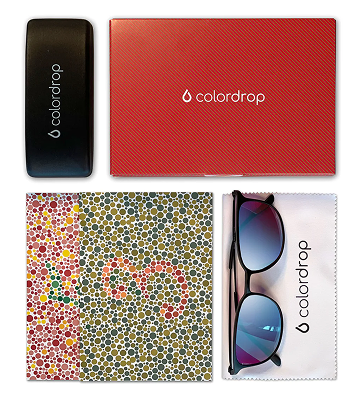
We pay attention to very high quality, not only with our colorblind glasses. This is what our standard Colordrop package looks like. It is meant to specifically resemble a gift package, to properly celebrate the "magic of color."
Contents of our shipping box:

Glasses for colorblind people
Softcase case
Glasses cleaning cloth
2x color plates from the official Ishihara test
Gift wrapping

Our researchers have designed special lenses with the Colordrop glasses to support colorblind people in color perception. Our glasses specifically help with red-green weakness.
Only small successes can mean a great enrichment for those affected in the long term. Wear the glasses as often as possible to achieve maximum success.

Multilayer technology only at colordrop
Different coatings provide support for colorblind people
The eyeglass lenses we developed for colorblind people feature a multi-layer color intensity coating. Our researchers have succeeded in finding the perfect color wavelengths for colorblind people.
The world is beautiful. If the ability to see cannot be maximized, this reduces the quality of life. This particularly affects color vision.
People who, for genetic reasons, lack the ability to perceive the environment in all its bright colors can now be helped: with our specially coated glasses, which change the continuous light spectrum in such a way that color vision deficiency can be corrected.
Our glasses for color blind people work differently on every person. One thing is certain: we have been researching visual aids that promise a colorful view for years. We can now even make these in individual prescriptions for our customers.
Color vision deficiency is more common than you might think. 300 million people worldwide are affected by it, mainly men. The red-green weakness is particularly present:
About 10% of men worldwide have difficulty distinguishing the colors red and green, but only 0.8% of women do. Complete color blindness, on the other hand, occurs much less frequently:
The Cause of color blindnesst is genetically determined.
That's why corrective glasses often represent a small miracle for people with color vision deficiency. The effect of sudden color vision is based on the technological production of the lenses and their special coating.
Although they do not cure color vision deficiency, they can trick the eye and actually create a colorful fireworks display in the brain.
The term Color blindness and Color ametropia are often used synonymously. In particular, the comparatively widespread red-green weakness is generally understood as color blindness, although there are important differences. People who have color vision deficiency perceive certain colors more weakly or cannot distinguish them correctly from other colors. The organs important for color vision are present, but they only work to a limited extent or in reduced numbers.
However, there is one Color blindness Before, certain colors cannot be seen at all. They seem gray. The elementary organs for color vision are not functional, i.e. defective. In addition, color blind people suffer from high sensitivity to glare and reduced visual acuity, which is exacerbated in moderate lighting conditions. The two limitations of sensory perception have in common that they always affect both eyes and are genetically determined, exist from birth and do not worsen over the course of life.
In order to be able to see the world in all its colors, you have so-called photoreceptors in the retina of your eyes. On the one hand, there are the so-called rods, which enable vision even at dusk, and the cones, which are responsible for perceiving colors. There are three different types of cones. The first cell type responds to red light, the second to green and the third to blue. Anyone who sees the entire color spectrum colorfully is called a trichromat.
If one of the cones doesn't work - maybe even two or all three - you have color blindness. In this case the corresponding color cannot be perceived. The technical terms for the different sub-forms of color blindness are:
Achromasia refers to the complete lack of color vision. The world of those affected consists only of different shades of gray. Monochromacy can involve red blindness (protanopia), green blindness (Deuteranopia) or blue blindness (tritanopia).
If all the cones are present and functional, but only work to a limited extent, color vision deficiency occurs, also known as color vision deficiency. If the green cone is not fully functional, those affected have difficulty clearly recognizing the color green and distinguishing it from red (Deuteranomaly). If the red cone causes problems, red is perceived less intensely and can hardly be distinguished from green (Protanomalie). These two limitations are known as red-green weakness.
If the blue cone works to a limited extent, the sensitivity to blue is reduced and the color can be less easily distinguished from yellow (tritanomaly). In all three forms of color vision deficiency, the colors can be seen - more or less intensely - but can be difficult to distinguish from other colors. Nevertheless, they are also colloquially referred to as color blindness.
Color blindness usually occurs from birth because its cause is genetic. In addition to congenital ocular color blindness (ocular = eye), which is based on missing or defective cone cells, cerebral color blindness (cerebral = brain) can also occur, which is caused by a neurological disorder. Illnesses, accidents, tumors, strokes or drug abuse can hinder the sensory processing of colors in the brain.
In contrast to acquired color blindness, the congenital form always occurs in both eyes and does not change in intensity over the years. Depending on the severity, those affected may not even be aware that their world is less colorful than that of people with normal vision; after all, they don't know it any differently. However, complete color blindness is usually diagnosed in infancy due to its pronounced symptoms.
For colorblind people, their surroundings are shades of gray. But that's not the only difficulty they have to deal with: those who are congenitally color blind automatically cannot see clearly. The reason is simple: Since their cone cells do not work correctly, they can only see with the help of other light-sensory cells: the rods. The place of sharpest vision in the eye is the fovea centralis, the fovea, a depression in the retina located in the center of the so-called yellow spot.
Here the cones are crowded together and there are comparatively few rods. But the cones don't work for color blind people, or there are far fewer of them than for people with normal vision. This leaves not enough functioning sensory cells to produce a sharp visual image. In the case of color blindness that is acquired later, the case is usually different, as the cause of the functional disorder lies not in the eye, but in the processing of perception.
Prescription glasses for color blind people do not work like a light switch that you flip. But they can help you perceive certain colors better. The types of cones in our eyes are each responsible for incident light of a specific wavelength. In the case of color vision deficiency, overlaps can occur, which means that the colors cannot be distinguished optically correctly. In this case, our glasses for color blind people achieve the best results.
For this purpose, the visual aids change the continuous light spectrum in such a way that the color-blind person receives the same stimulus as a person with normal vision. Those affected will experience a colorful miracle when they put on a color blind visual aid for the first time, but of course the glasses cannot treat the cause.
It looks like sunglasses and its technology is based on the same principle:
This depends on the individual findings. For example, whoever Red Green weakness usually perceives red and green as the same color. The glasses for color blind people can filter out a disturbing color, i.e. a specific wavelength. This helps to visually separate the colors and trick the brain. This trained effect of recognizing filtered light signals as colors remains even after you take off the glasses.
Our special glasses are innovatively coated and are increasingly optimized. But unfortunately there is no guarantee. The reactions of the eyes and brain to the glasses can vary greatly from person to person and also depend on the diagnosis.
If the symptoms are mild, there is usually no major effect; the same applies to complete color blindness, which rarely occurs. Anyone who suffers from red-green deficiency can be happy in this case: 95% of those who test glasses for color blind people find that their color vision deficiency is optically corrected!
The most important thing about color correction glasses are the lenses. You can now easily insert them into your favorite glasses. This way you can be sure that it is comfortable to wear in everyday life and still fits your face perfectly. It is best to have them made directly to your individual prescription; progressive lenses can now also be coated accordingly.
To do this, register via E-mail or arrange one recall with us.
To be completely sure which type of color vision deficiency is present and should be corrected with the visual aid, you can first take a test from an ophthalmologist. The Ishihara color test charts usually provide a first clue.
In a colorful mix of circles of different sizes, numbers and symbols are hidden on the colorful images that only people with normal vision can recognize. They are based on the ability to differentiate the entire color spectrum. If an initial suspicion is confirmed, the optician will be able to make an exact diagnosis with further special tests.
Glasses for color blind people are the innovative result of decades of research. In order to understand the effect, you should familiarize yourself with the process of sensory perception “seeing”: This fascinating and complex ability is made up of the manipulated variables light, sensory cells and the brain. Everything around us reflects light in different wavelengths and hits the photoreceptors of the retina in our eyes. Our cone cells contain the pigment rhodopsin, which is composed of the protein opsin and the molecule 11-cis-retinal. The opsin differs in its structure within the three cone types, so that they are differently sensitive to light:
If long-wave light hits the eye, the red cones become active and transmit the “red” information to the brain. If there is a red weakness, the maximum sensitivity in the R cone shifts towards green. The red cones no longer cover the entire wavelength range of this color and react more strongly to green light. At this point, the glasses have a corrective effect when sorting for color blind people. And red becomes red again.
The genes for the opsins are located on the X chromosomes. Anyone who knows this will immediately understand why men suffer from color vision deficiency much more often than women. If there is a defect in this gene, as is the case with inherited diseases, women can compensate for a malfunction with their second X chromosome. Men don't have this option. Women would have to have a gene defect on both X chromosomes, which is very rare.
Color vision deficiency can lead to significant difficulties and limit active participation, especially in road traffic. Even those who are professionally dependent on clearly recognizing the signal colors, for example as a police officer, pilot or ship captain, will - if this is severe - have to look for another dream job. Glasses are therefore extremely helpful for color blind people in everyday life. Traffic signs can now be clearly recognized again, which quickly leads to a considerable feeling of safety among those affected. The differentiated perception of plants, fruit and vegetables at the market stall, colorful fashion and furniture leads to an invaluable improvement in the quality of life in the long term.
And once you've tried our glasses for color blind people, you won't want to be without them again.


